Column addition and subtraction: carrying and borrowing explained
Column addition and subtraction is the written method for adding and subtracting bigger numbers: you line the digits up in place-value columns and work one column at a time, starting with the ones. The real challenges are three: lining up correctly, carrying and borrowing (what US schools call regrouping). Here they are with real numbers, including the dreaded zero in the middle.
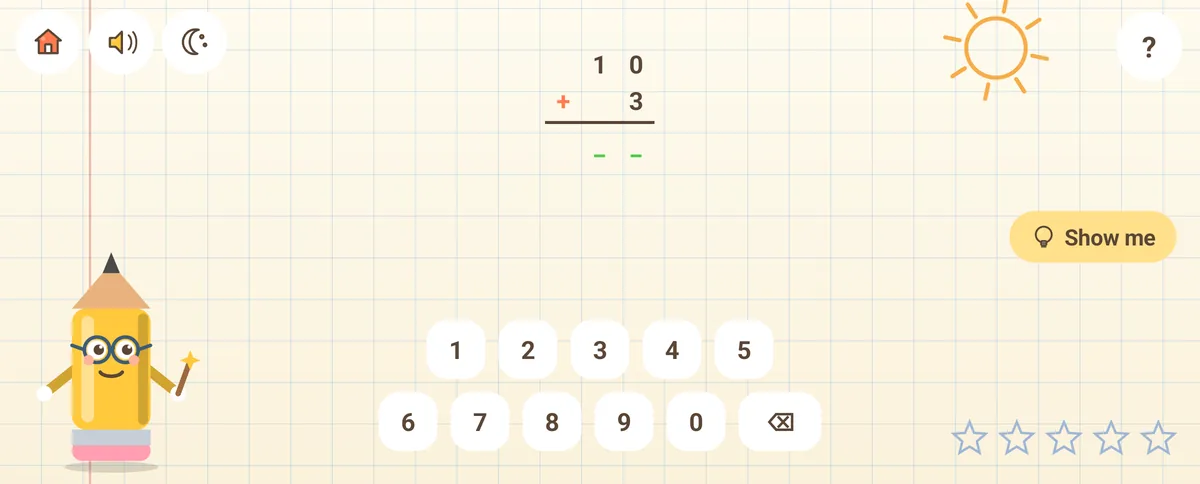
Lining up is half the job
Many column math mistakes happen before any calculating: the numbers are lined up wrong. Ones under ones, tens under tens, hundreds under hundreds. Graph paper is a great help: one digit per square, everything aligned to the right.
With numbers of different lengths, like 305 − 87, kids tend to line them up on the left. Have them write H, T, O (hundreds, tens, ones) above the columns until lining up becomes automatic.
Always start with the ones
Column math goes from right to left: ones, then tens, then hundreds. The reason is carrying: whatever spills over from the ones goes into the tens, and you can't know it until you've worked out the ones.
Kids usually learn 2-digit addition and subtraction without regrouping first (34 + 25), then with regrouping (38 + 47), then 3-digit numbers by 2nd and 3rd grade. Multiplying a multi-digit number by one digit in columns follows the same logic: multiply the ones, carry the tens, move to the next column.
Carrying in addition
38 + 47: in the ones, 8 + 7 = 15. Write 5 and carry 1 into the tens, writing it small at the top. Then 3 + 4 + 1 = 8. Answer: 85.
The classic mistakes are forgetting the carried 1 (answer 75) or writing the whole 15 in the ones column (answer 715). Have your child say aloud: “15 is 1 ten and 5 ones.” Base-ten blocks, or dimes and pennies, show clearly how ten ones turn into one ten.
Borrowing in subtraction
52 − 27: in the ones, 2 − 7 doesn't work, so you borrow a ten. The 5 in the tens becomes 4, the 2 in the ones becomes 12. 12 − 7 = 5, then 4 − 2 = 2. Answer: 25.
The typical mistake is subtracting the smaller digit from the bigger one inside the column (7 − 2 = 5) without regrouping. The result, 35, looks reasonable, which is exactly why it's hard to catch. Use the same words and method your child's teacher uses, so they don't have to juggle two procedures.
The zero in the middle, and checking
305 − 87 stumps almost everyone. In the ones, 5 − 7 doesn't work; in the tens there's a 0, so there's nothing to borrow. You have to go to the hundreds: the 3 becomes 2, the 0 in the tens becomes 10, then gives one ten to the ones and becomes 9, while the 5 becomes 15. Now 15 − 7 = 8, 9 − 8 = 1, 2 − 0 = 2. Answer: 218.
When you're done, always check. For subtraction, add the answer to the number you took away: 218 + 87 = 305, so it's right. For addition, an estimate beforehand helps: 38 + 47 is about 40 + 50 = 90, so 85 makes sense and 715 doesn't.
How Lalo Academy practices it
Lalo Academy's math game offers 2- and 3-digit column addition and subtraction, with and without carrying and borrowing (including subtractions with a zero in the middle), then column multiplication by one digit and division with remainders. Digits are typed from the right, ones first, exactly as the written method works.
When your child doesn't know how to go on, a button explains the problem column by column, talking through every carry and borrow. Mistakes are always gentle: the right answer is shown and explained. Sessions last 5–10 minutes, and column math is one of the games unlocked by the one-time purchase, with no subscription.
FAQ
What grade do kids learn column addition and subtraction?
Most children start adding and subtracting 2-digit numbers in columns in 2nd grade, first without and then with regrouping. In 3rd grade they move on to 3-digit numbers and often to column multiplication.
Is regrouping the same as carrying and borrowing?
Yes. Regrouping is the term many US schools use for both: trading ten ones for a ten when adding, and a ten for ten ones when subtracting.
Why does my child get subtractions with zeros wrong?
With a zero in the tens there's nothing to borrow, so the borrowing has to start from the hundreds. It's a two-step move: practice it on its own with a few examples like 302 − 45 or 400 − 126.
How do you check a subtraction?
Add the answer to the number you subtracted: you should get the top number. For 305 − 87 = 218, the check is 218 + 87 = 305.