How to teach kids to tell time, step by step
To tell time on an analog clock, a child has to put three things together: tell the two hands apart, count minutes by fives, and know the words we use for times. It's learned in steps, from o'clock to five-minute intervals, and with a little practice every day it becomes second nature.
Start with the two hands
The short hand shows the hour, the long hand shows the minutes. It sounds obvious, but it's the number one mix-up: many kids see the long hand on the 3 and say “three o'clock”. Give each hand a simple rule: the short one is slow and tells the hour, the long one is fast and goes all the way around in one hour.
A real clock to hold, or a paper plate clock with moving hands, beats any explanation. Turn the long hand one full circle and watch together as the short hand moves just one number.
The right order: o'clock, half past, quarters, 5 minutes
Begin with o'clock: long hand on the 12, short hand on the hour. Then half past (long hand on the 6), then quarter past and quarter to (on the 3 and the 9), and finally five-minute steps. In most US schools, kids read hours and half hours in 1st grade and times to the nearest five minutes in 2nd grade.
For five-minute steps, the 5 times table is the key: the long hand on the 4 means 4×5 = 20 minutes, on the 8 it means 40. That's why the clock and the 5s are often taught side by side.
- O'clock: 3:00, 7:00.
- Half past: 3:30.
- Quarter past and quarter to: 3:15, 3:45.
- Five-minute steps: 3:20, 3:40.
The hour hand moves between the numbers
At 3:30 the short hand isn't on the 3: it's halfway between the 3 and the 4. At 3:45 it's almost on the 4. This is where the most common mistake comes from, reading “4:30” when it's really 3:30.
The rule to teach: the hour is always the last number the short hand has passed. If it sits between 3 and 4, it's still three-something. Drawing clocks with the short hand in in-between positions helps the idea stick.
How we say the time in English
English gives kids two ways to say most times. 3:30 is “three thirty” or “half past three”; 3:15 is “three fifteen” or “quarter past three” (also “quarter after three” in the US). 3:45 is “three forty-five” or “quarter to four”: you name the hour that's coming and subtract a quarter of an hour.
“Quarter to” is confusing because the hour you say isn't the one the short hand is pointing past, so introduce it only once “half past” and “quarter past” are solid. It's also a good moment to explain a.m. and p.m.: 7:00 a.m. is breakfast, 7:00 p.m. is dinner.
From analog to digital and back
Kids see digital times everywhere: on the microwave, the phone, the car. Linking the two formats strengthens both. 7:05 on a screen means the long hand on the 1 and the short hand just past the 7; 7:30 is “seven thirty” or “half past seven”.
Daily practice beats a stack of worksheets: ask the time at breakfast, before leaving the house, at dinner. One minute a day in real situations does more than half an hour at the table.
How Lalo Academy practices it
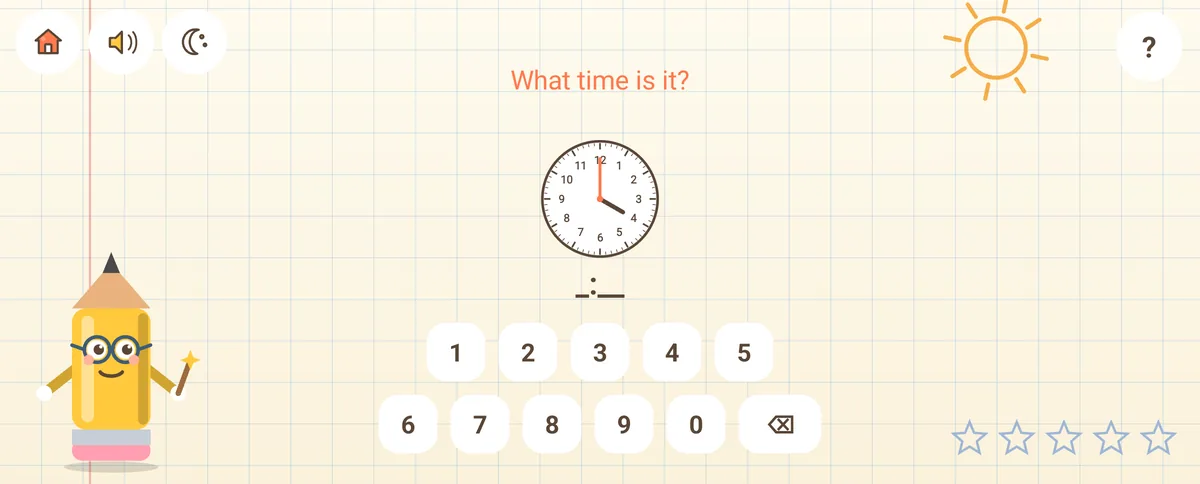
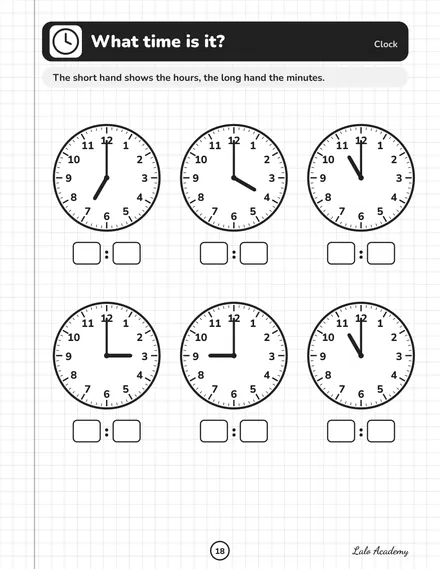
Lalo Academy's clock game draws an analog clock on the screen, with the hour hand moving along with the minutes just like a real clock. Skills unlock in order: o'clock, half past, quarters, then five-minute steps. Your child reads the clock face and types the time in digital form on the keypad.
In another game it works the other way round: a digital time appears and your child taps the right clock among three, where one decoy often has the hands swapped. Sessions last 5–10 minutes, and when an answer is wrong, the correct time is shown and explained calmly. The clock is one of the games unlocked by the one-time purchase.
FAQ
What age do kids learn to tell time?
Hours and half hours usually come in 1st grade, around age 6 or 7; quarter hours and five-minute steps in 2nd grade, around 7 or 8. Every child has their own pace: short, frequent practice is what counts.
Should I teach digital or analog time first?
Digital is easier to read, but an analog clock shows time passing and what a quarter of an hour looks like. Work on both and connect them.
Why does my child say 4:30 when it's 3:30?
They're looking at the number nearest the short hand instead of the last one it passed. Remind them the hour stays the same until the short hand reaches the next number.
How do I explain “quarter to”?
Show that there are 15 minutes left until the next hour: at 3:45 there's a quarter of an hour to go before 4, so it's quarter to four. Introduce it after “quarter past” is solid.