Spelling practice at home: a simple guide for grades 1–3
Good spelling practice connects listening and writing: your child hears a word and has to turn it into the right letters. At home it works best when sessions are short, focus on one spelling pattern at a time, and bring back misspelled words over the following days. Here is how to set it up and which patterns matter most in the early grades.
How to run a spelling session at home
Say the word clearly at a normal pace, use it in a short sentence, then say it once more. This little dictation routine (word, sentence, word) gives meaning to the word without over-pronouncing it in a way your child won't hear at school.
Let them write without interruptions, then check together at the end. Ask them to read each word aloud as written: they often spot the mistake themselves. Six to eight words, or three short sentences, are enough for one session.
- Listen to the whole word first, then write.
- 1st grade: short familiar words. From 2nd grade: simple sentences.
- One pattern at a time: double letters today, silent letters tomorrow.
- Misspelled words go back on the list for the next few days.
Double letters and vowel teams
Double consonants are a classic trap: rabbit, apple, butter, summer, kitten. A helpful clue is that a short vowel sound is often followed by a double letter in the middle of a word (hap-py, din-ner). Clapping the syllables makes the pattern easier to hear.
Vowel teams are the other big early pattern: ee and oo in green, sheep, tree, moon, spoon, school. Group words that share a team and read them together, so your child learns to see the pattern instead of guessing letter by letter.
Silent letters: knee, lamb, write
English has letters you see but don't hear: the k in knee and knife, the b in lamb and climb, the w in write and wrong, the h in hour and ghost. They can't be sounded out, so they're best learned as small families.
Make it a game: say “knife” and ask “which letter is hiding?”. Keep a short list of silent-letter words on the fridge and add a new one each week. Knowing that these words are tricky on purpose makes kids less frustrated when they get them wrong.
th, ch, sh and ck
Digraphs are two letters that make one sound. Th appears in this, that, three, mother and bath; sh in fish, shop and ship; ch in chair, cheese and lunch. Ck comes at the end of short words after a short vowel: duck, black, clock.
A common mistake is writing just one letter (“fis” for fish) or swapping ch and sh. Have your child say the word slowly with a hand under their chin: the sound is one sound, but it needs two letters. Later in 2nd and 3rd grade schools add more patterns, such as silent e (cake, bike), -tch (catch) and plurals.
From words to sentences, and words that come back
Once single words are solid, move to short sentences: “The cat is black.”, “We go to school.”. Three new things appear here: a capital letter at the start, spaces between words and a period at the end. They seem small, but they're the most common errors in early sentence dictation.
Misspelled words are valuable. Write them down and bring them back a few days later, mixed with new ones. A word missed twice deserves a permanent spot in review until it comes out right without hesitation. That repetition is what moves a word from the weekly spelling test into long-term memory.
How Lalo Academy practices it
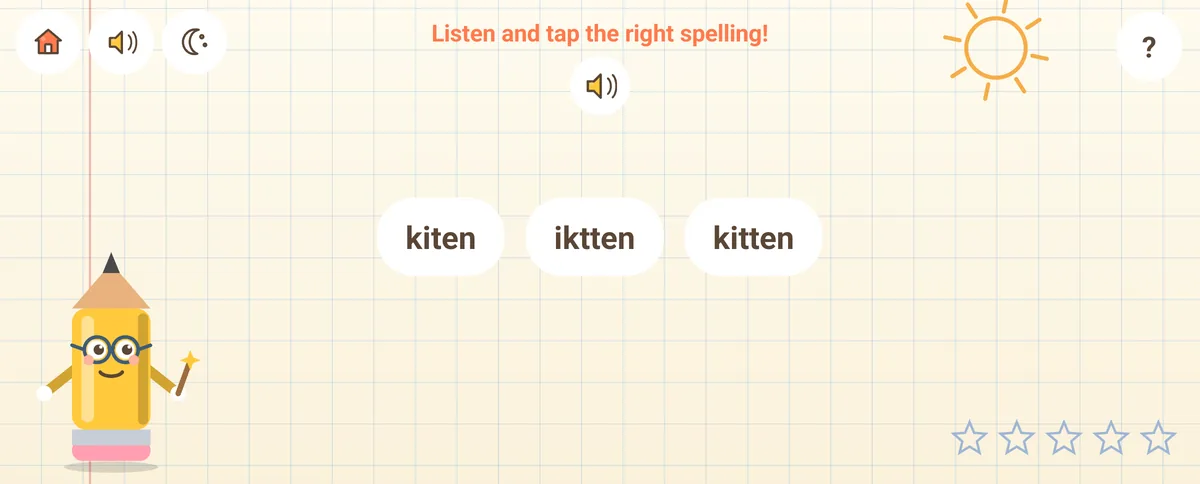
In Lalo Academy's spelling game a natural recorded voice, not a synthetic one, says the word. In the first rounds your child taps the correct spelling among three, then types it alone on the letter keyboard. The English categories follow the patterns above: double letters, silent letters, th, vowel teams like ee and oo, and ch, sh and ck, ending with short sentences that need a capital letter, spaces and a period.
Every misspelled word comes back in later sessions until it's learned, and mistakes are always gentle: the right spelling is shown straight away. The parent area lists the words to review. Spelling is one of the games unlocked by the one-time purchase; Numbers and Times tables are free.
FAQ
How many spelling words should a 1st grader practice?
Five to eight short, familiar words per session is enough, focused on one pattern. From 2nd grade you can add two or three short sentences.
Is a dictation the same as a spelling test?
They're close: in a spelling test you say single words, in a dictation you read a short sentence. Both train the same skill, turning sounds into letters, and sentences add capitals and punctuation.
My child spells words the way they sound. Is that a problem?
It's a normal stage between 5 and 8. Praise the sounds they got right, then show the pattern they missed, especially silent letters and double letters, which can't be heard.
Should I correct mistakes right away or at the end?
At the end. Interrupting breaks concentration, while reading back together afterwards helps your child find mistakes on their own.