Counting money and making change: a guide for kids
Counting money is math your child can hold: skip counting by 5s, 10s and 25s, addition, subtraction and a first taste of decimals. To use money confidently, kids need to recognize coins and bills, count starting from the biggest value, and make change. Here is a simple path to follow at home.
Know your coins and bills
Before counting, kids need to recognize each piece. In US money there are pennies (1¢), nickels (5¢), dimes (10¢) and quarters (25¢), plus $1, $5, $10 and $20 bills. Most US schools cover coins and bills in 2nd grade.
A common mix-up is thinking a bigger coin is worth more: the dime is smaller than both the penny and the nickel, yet worth more than either. Line the coins up from lowest to highest value and let your child handle them: the value is written on the coin, not shown by its size.
Count from the biggest value down
To count a handful of money, sort it from the highest value to the lowest and skip count. A dollar bill, two quarters, a dime and a nickel: “one dollar, a dollar twenty-five, a dollar fifty, a dollar sixty, a dollar sixty-five.” This is where counting by 5s, 10s and 25s pays off.
Start with coins only (up to one dollar), then whole dollars, then mixed amounts like $3.50. Explain the decimal point: $3.50 means 3 dollars and 50 cents, and 100 cents make 1 dollar.
- Coins only: 25 + 25 + 10 + 5 = 65¢.
- Whole dollars: $10 + $5 + $1 + $1 = $17.
- Mixed amounts: $1 + $1 + $1 + two quarters = $3.50.
Make change by counting up
Change can be worked out with subtraction, but kids, like many cashiers, do better counting up from the price to the amount paid. The price is $7 and you pay with $10: “8, 9, 10”, so the change is $3.
With cents it's the same idea in two hops: first up to the next whole dollar, then up to the bill. The price is $6.40 and you pay with $10: from $6.40 to $7 is 60 cents, from $7 to $10 is 3 dollars. Change: $3.60.
Common mistakes and how to fix them
They're nearly always the same ones, and hands-on practice fixes them better than worksheets.
- Mixing up cents and dollars, writing $350 instead of $3.50: always say the unit out loud.
- Forgetting that 100 cents make a dollar: actually trade 4 quarters for a dollar bill.
- Counting coins instead of their value: five coins are not five cents, or five dollars.
- Getting change wrong across a zero: $10 − $6.40 is a case where counting up is safer than subtracting.
Play store
The most effective way to learn is a pretend store at home: price tags in whole dollars for younger kids ($3, $5) and with cents from 2nd grade ($1.20, $2.50). One child is the cashier, the other pays, then they swap.
Whenever you can, let your child pay at the bakery or a market stall with real money, and check the receipt and the change together. Ten minutes of play is worth more than a page of exercises, and money becomes something real.
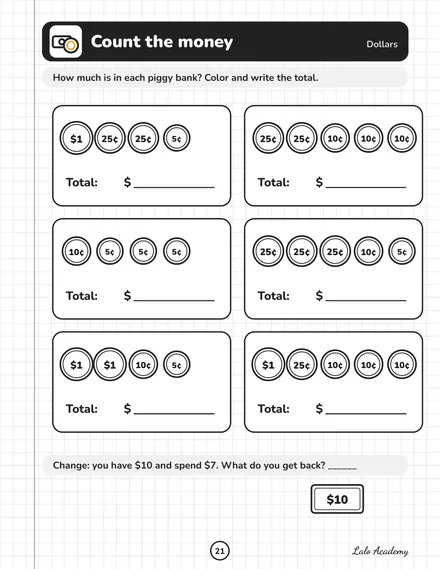
How Lalo Academy practices it
In Lalo Academy's money game, US coins and bills are drawn in their colors: silver nickels, dimes and quarters, plus dollar bills. Skills follow an order: counting cents, counting whole dollars, mixed amounts like $3.50, then making change from a $10 or $20 bill.
The last skill asks for exact change with cents, for example from $10 for something that costs $7.50. If your child gets it wrong, the right amount is shown and explained right away, with no scolding. The money game is unlocked by the one-time purchase; the app has no ads and works offline.
FAQ
What age should kids learn to count money?
Kids can start recognizing coins around 6; counting mixed amounts and making change usually comes in 2nd and 3rd grade, along with a first look at decimals.
Real money or play money?
Play money is fine to start, as long as it looks like the real thing. As soon as you can, use real coins: weight and size help kids tell them apart.
How do I explain the decimal point in prices?
Dollars come before the point and cents after it: $2.50 is 2 dollars and 50 cents. With real coins on the table it becomes obvious.
My child gets change wrong. What can I do?
Teach them to count up from the price to the amount paid, first to the next whole dollar and then to the bill. It's more natural than subtracting and easy to check with coins.