How to learn the times tables: the right order, tricks and practice
A child really knows the times tables when they stop counting on their fingers and simply know that 7×8 is 56. The approach that works starts with the easy tables, uses the commutative property to cut the work in half, and reviews each fact at growing intervals. A few minutes a day is enough, as long as it happens most days.
What order to learn the times tables in
Going from 1 to 10 looks tidy on a worksheet, but it isn't kind to memory. Start with the tables that lean on things your child already knows: the 2s (doubles), the 10s (add a zero) and the 5s (half of the 10s, nickels, minutes on the clock). Then the 3s and the 4s, which are just the 2s doubled.
The 6s, 7s, 8s and 9s come last, and by then half of their facts are already known: 6×2, 7×5 and 8×10 were learned with the earlier tables. Most schools introduce multiplication in 2nd or 3rd grade and expect fluency with facts up to 10×10 by the end of 3rd grade.
- 2s: doubles (2, 4, 6, 8…)
- 10s: add a zero
- 5s: half of the 10s
- 3s and 4s: the 4s are the 2s doubled
- 6s, 7s, 8s, 9s: only a handful of new facts left
The commutative property cuts the work in half
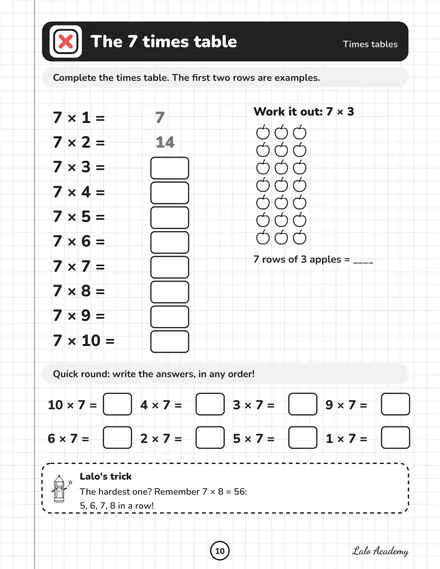
A 10×10 multiplication chart has 100 squares, but there are far fewer facts to remember. 3×7 and 7×3 give the same answer: show it with an array of objects, three rows of seven, then turn the paper and you have seven rows of three. Nothing was added or taken away.
Count each pair only once and the number of different facts drops to 55. Take out the ×1 and ×10 facts, which need almost no memorizing, and the list is shorter still. Telling your child this is a real relief: the mountain is smaller than it looked.
Recall, not counting
Chanting the 7s like a song isn't the goal. If your child has to start from 7×1 to reach 7×8, that fact isn't theirs yet. What you want is direct recall: a random question, an instant answer.
Spaced repetition gets you there. Review a new fact the next day, then a few days later, then a week later; if it's missed, it goes back to being reviewed more often. In practice, five minutes every day beats an hour on Sunday. And mix the questions up, otherwise kids learn the sequence rather than the answers.
The hard ones: 6×7, 7×8, 8×9
Almost every child stumbles on the same facts: 6×7, 6×8, 7×8, 8×8, 7×9. For these, give them a stepping-stone strategy to use until the answer becomes automatic.
- Double it: 8×6 is double 4×6, so 24 + 24 = 48.
- Start from a nearby fact: 7×6 = 7×5 + 7 = 35 + 7 = 42.
- Use the 10s for the 9s: 9×7 = 10×7 − 7 = 70 − 7 = 63.
- Check the 9s: the digits of the answer add up to 9 (6+3, 7+2, 8+1).
No timers, just confident answers
Racing against a clock raises anxiety and pushes kids to guess. Speed comes on its own as a side effect of memory: once a fact is truly learned, the answer pops out in a couple of seconds without counting.
When your child gets one wrong, calmly show the right answer and ask the same fact again two or three questions later. A mistake is information, not failure. And celebrate specific progress: “you knew 7×8 right away today” means more than a generic “good job”.
How Lalo Academy practices it
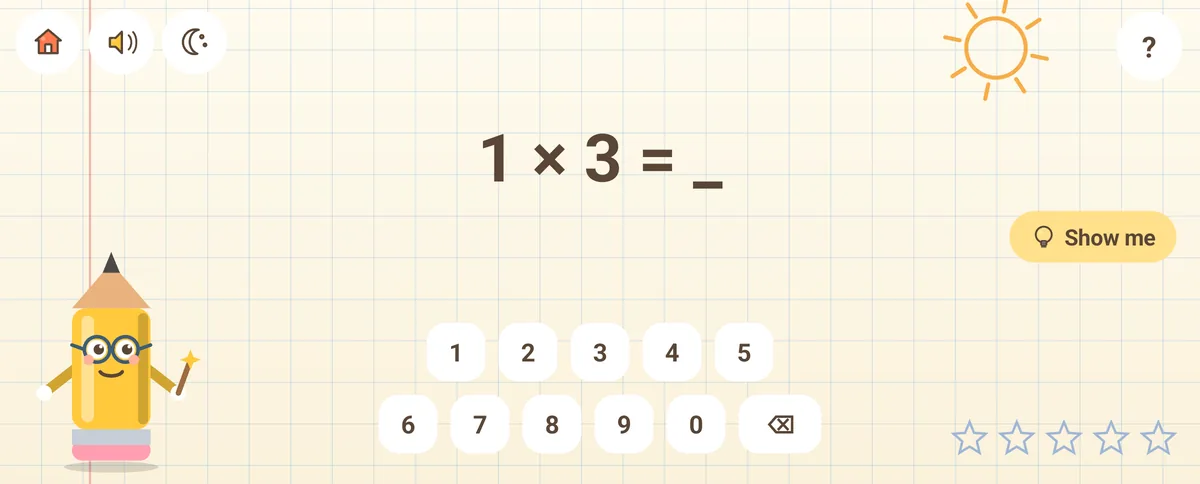
In Lalo Academy the times tables game is free and follows the order 2, 10, 5, 3, 4, 6, 7, 8, 9. Each new fact is first shown as an array of objects, then your child types the answer on a keypad: no multiple choice, so no lucky guesses. There is never a timer on the screen.
A fact only counts as learned when it's answered correctly and quickly on different days: it comes back after one day, then three days, one week and three weeks. If your child gets stuck, a button shows the array step by step, and Blitz mode mixes up the facts they've already met. The PIN-protected parent area shows progress for every table.
FAQ
What age should kids learn their times tables?
Most children start multiplication around 7 or 8, in 2nd or 3rd grade, beginning with the easy tables. It helps if they first understand multiplication as repeated addition before memorizing facts.
How long should my child practice each day?
Five to ten minutes a day is plenty. Consistency matters more than length: short reviews spread across the week stick better than one long session.
My child knows them in order but not mixed up. What should I do?
That's normal: they've memorized the sequence. Ask mixed questions, starting with the tables they know best, and when they get stuck, suggest a nearby fact instead of letting them count up from the start.
Which times table is the hardest?
For many kids it's the 7s and 8s, especially 7×8 and 6×7. Thanks to the commutative property, though, by the time you get there only a few facts are actually new.